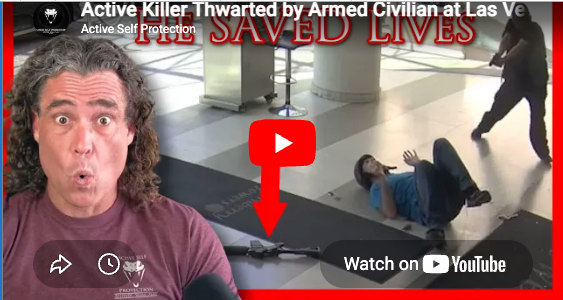
Location: Las Vegas, Nevada
Video Source: Active Self-Protection (John Correia & Stephanie Widner)
People who argue that good guys with guns never stop active killers haven't seen this footage.
A man with an AR-pattern rifle walked the hallways of a Las Vegas residential tower, fired at a security guard, and was heading for the street — where dozens more people were within range. He wasn't stopped by law enforcement. He wasn't stopped by trained security.
He was stopped by Humberto Garcia, an employee working in shipping and receiving, who heard something, went to investigate, and made a decision that almost certainly saved lives.
This is one of the clearest real-world examples of what it means to be armed, present, and willing — and what separates someone who ends a threat from someone who just witnesses one.
Let's break down exactly what happened and what we can learn from it.
What Happened
The incident begins inside the tower. The attacker — a guest of a resident — retrieved an AR-pattern rifle from his uncle's unit and began wandering the hallways with the weapon raised in a two-handed carry. Multiple people passed him. Nobody called 911. Nobody intervened.
He made his way to the lobby, where he fired at a security guard. His rifle malfunctioned — a malfunction that very likely saved lives in that moment. The security guard hit the deck, survived, and fired one round back that missed entirely. The attacker then moved outside, walking around the exterior of the building.
That's where Humberto Garcia came in.
Garcia was working the shipping and receiving area when he became aware that something was wrong. He didn't wait for confirmation. He went to find out — and came around the corner to see the attacker advancing with the AR.
Garcia stood his ground. Two hands on the pistol. Stable stance. Accurate fire — rounds to the legs and abdomen. The attacker went down immediately and stopped resisting.
Garcia then kicked the rifle well away from the downed attacker, kept watch, and — before police arrived — unloaded his pistol, set it down with his magazines and holster in plain sight, and waited. Police arrived several minutes later.
No additional victims. Threat ended. One armed employee.
Lesson 1: Bystanders Normalized a Man Walking With a Rifle
This is perhaps the most sobering part of the footage.
Multiple people walked past this man — a rifle raised in a two-handed grip, a bike helmet worn indoors — and did nothing. Their brains, as John Correia puts it, worked overtime to explain it away. He probably has a reason. This probably isn't what it looks like.
This is called normalcy bias — the mental tendency to interpret ambiguous situations as safe, even when the evidence suggests otherwise. It's not weakness. It's how human brains are wired. But in an active threat scenario, it is dangerous.
The lesson: be curious about your world. Not paranoid. Not hypervigilant to the point of misery. Just curious. When something looks genuinely off — a rifle, erratic behavior, someone moving with clear hostile intent — don't let your brain explain it away. Accept the reality of what you're seeing and make a decision. Any decision is better than standing still while someone works up to firing.
Lesson 2: Malfunctions Are Common — and They're Your Window
The attacker's rifle malfunctioned at a critical moment. This isn't coincidence. It's a pattern.
Active killers, as a group, tend to use poorly maintained firearms — guns that haven't been lubed, tested, or quality-checked. The instructors at Active Self-Protection note that malfunctions show up in this type of incident with striking regularity. Some attackers have even been documented stopping to Google how to clear their firearms mid-event.
If you find yourself in an active threat situation and the shooting stops — there is a high probability the weapon has malfunctioned.
That lull is your moment. Whether you're armed or not. Whether you're running for an exit or positioning to engage. The pause in fire is information, and it's often the best window you'll get.
Lesson 3: Armed and Present Isn't Enough — You Have to Be Willing
The security guard in this incident was armed and present. He was not willing — at least not in any effective way. He fired one round in the attacker's general direction and fled. Nobody was hit. The attacker wasn't deterred. The threat continued.
Garcia, by contrast, was armed, present, and willing. He made the deliberate choice to engage. He stood his ground. He delivered accurate, fight-stopping hits.
The difference between these two outcomes isn't really about skill — it's about a decision made before the moment arrived.
Garcia had clearly thought through this. When the moment came, his mental resources weren't consumed by panic. He wasn't searching for a decision. He had one. His body went where his mind had already been.
That's the concept worth sitting with: the body won't go where the mind's never been. Mental rehearsal isn't a guarantee of perfection, but it is the difference between acting and freezing. If you carry — or if you keep a firearm staged at home — have you thought through what you would actually do if you needed it? Not just the mechanics of the shot, but the whole sequence: recognize, decide, act, follow up, secure the scene, communicate with arriving officers.
Garcia had. You could see it in every decision he made after the shots were fired.
Lesson 4: Good Hits End Fights. Misses Don't.
The security guard missed. The attacker kept moving.
Garcia connected — legs and abdomen — and the fight was over immediately. The attacker laid down and stopped.
This is worth stating plainly: misses don't end gunfights. A round that doesn't hit the threat does nothing to stop it, and in a populated environment, it creates a second threat entirely — an uncontrolled projectile traveling somewhere you didn't intend.
Garcia's hits weren't perfect. They weren't center mass under ideal range conditions. But they were fight-stopping, and that's what matters. He got solid hits from roughly 8 to 10 yards, under extreme stress, against a man carrying a rifle. That's not luck — that's preparation and a calm enough mind to execute under pressure.
If you carry, train for accuracy under stress. Not just static target work. Movement. Decision-making. Scenario-based drills. The goal isn't to be a competition shooter. The goal is to be accurate enough, fast enough, when the worst moment of your life is happening.
Lesson 5: What Happens After the Shots — Garcia Got This Right Too
This part gets overlooked, but it matters.
After the attacker went down, Garcia didn't relax into chaos. He stayed purposeful:
- He moved to the downed attacker and kicked the rifle well away, removing any chance it could be retrieved.
- He monitored the attacker without continuing to fire after the threat had stopped.
- Before police arrived, he unloaded his pistol, set it down with his magazines and holster, and waited with empty hands visible.
That last point is critical. Responding officers arriving to an active shooter call see a chaotic scene. They do not know who the good guy is. A person standing over a downed body holding a gun is not immediately identifiable as the defender — they are a potential threat until proven otherwise.
Garcia's choice to disarm himself before officers arrived almost certainly prevented a catastrophic misidentification. If you carry, have a plan for this moment. Whether that's holstering before officers arrive, setting the gun down, or verbally announcing yourself — have a plan and execute it calmly.
How This Connects to Home Defense Readiness
Garcia had something that most people don't think about until it's too late: his firearm was on his person and immediately available.
He didn't have to go find it. He didn't have to remember where he'd left it. He didn't have to fumble with a combination lock while an active threat was 30 feet away.
That accessibility made the difference between ending the threat and being another bystander.
The same principle applies at home. A firearm locked in a traditional gun safe in a back closet is secure — but in a home defense scenario, it might as well not exist. By the time you've crossed the house, opened the safe, and retrieved your firearm, the situation has already resolved itself — one way or another.
This is exactly why gun concealment furniture was designed: to give responsible gun owners fast, reliable access to a defensive firearm without sacrificing security or aesthetics.
A concealment shelf staged near your bedroom door, at the top of your stairs, or in the main living area gives you what Garcia had — a firearm within reach when seconds matter. It doesn't look like gun storage. It looks like a shelf. Nobody walking through your home would know the difference. But you know exactly where it is and exactly how to access it.
Our gun concealment furniture uses RFID-activated drop-down access, so there's no combination to fumble with, no key to find. One motion. Immediate access.
For gun owners who want that same readiness Garcia demonstrated — not just the gear, but the staged, accessible, immediately retrievable firearm — concealment furniture is the answer that traditional gun storage was never designed to provide.
A Note on the Aftermath
The attacker in this incident received probation.
Both Correia and Widner expressed shock at that outcome, and frankly, it's hard to argue with them. This man fired at a security guard in a populated residential building. The footage shows deliberate targeting. Probation strains comprehension.
We'll leave the legal system to do what it does. But it is a reminder that the justice system's timeline and the threat timeline are very different things. In the moment, you are your own first responder. Police arrived several minutes after Garcia had already ended the threat. They couldn't have arrived faster. It's not a criticism — it's physics.
Final Thought
Humberto Garcia wasn't a police officer. He wasn't a trained security professional. He was a man working a shift in shipping and receiving who heard something, went to see what was happening, and made a decision that almost certainly saved multiple lives.
He did it because he had thought it through. Because when the moment came, the decision was already made.
Armed. Present. Willing.
That's the standard. That's what preparation looks like when it matters most.
If Garcia's story resonates with you — if it reinforces why you carry, why you train, and why you think carefully about where your firearm is staged at home — we'd encourage you to check out our gun concealment furniture and gun concealment mirrors. Built for people who take home defense seriously without wanting their home to look like an armory.
Because preparation shouldn't be visible to everyone.
Only to you.


