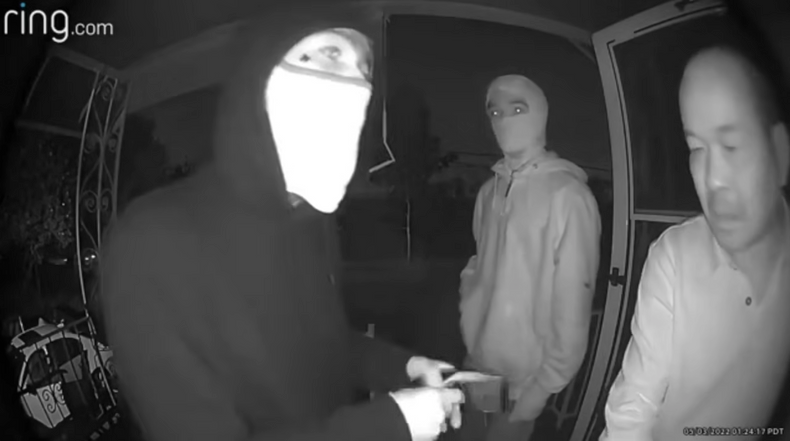
Location: Columbia City, Seattle, Washington
Video Source: Humilitas First (Ret. Lt. Todd Heaton)
It's 1 in the morning. You've just dropped your wife off at work and you're pulling into your own driveway. Thirty seconds from your front door. Home.
Three masked men rush you before you make it up the steps. One has a gun pointed at your chest. They force you inside, ransack your home, and leave with $500 in cash, jewelry, a gold bracelet you've owned for 20 years, and $3,000 you had set aside for bills.
This happened to a man named Sunville in Seattle's Columbia City neighborhood — the 74th violent or property crime recorded in that neighborhood alone that year, and it was only May.
Ret. Lt. Todd Heaton of Humilitas First breaks this one down with surgical precision. The lessons aren't just about what Sunville could have done differently. They're about understanding how criminal crews think — and using that knowledge to stay ahead of them.
What Happened
Sunville believes he was followed home from a local casino. When he pulled into his driveway and got out of his car, a vehicle parked nearby — offset slightly, headlights facing away — had already positioned its crew. By the time Sunville turned his back to walk toward his front steps, three men were already sprinting toward him.
From car to confrontation: roughly 90 feet, covered in five to six seconds. By the time he reached his front door, a gun was at his chest. They forced him inside and took everything they could carry.
He survived. But as Heaton points out — this man now knows exactly what to watch for. It will not happen to him again.
Lesson 1: Criminals Understand Timing and Distance Better Than Most Victims
The crew that hit Sunville weren't improvising. Every choice they made was deliberate.
They parked offset — not directly behind his car — so that even if he noticed the vehicle stopping, his brain would file it as not my problem, that's in front of my neighbor's house. They waited until he was out of the vehicle and moving toward his door before they moved, because a man on foot with his back turned is far more vulnerable than a man still seated in a car who can simply drive away.
Their doors were already opening before the car stopped. They were sprinting while he was still walking.
They stole time. And they did it by understanding exactly how much of it they needed.
This is the mindset worth adopting — not with paranoia, but with awareness. Criminals who do this for a living have worked out the geometry of ambush. The driveway, the front steps, the moment between your car and your front door — these are transitional spaces, and they are where the overwhelming majority of violent crimes against homeowners occur. Not inside the home. On the way to it.
Lesson 2: Know Where You Are — Crime Is Not Evenly Distributed
Heaton makes a point that deserves more attention than it typically gets: crime is geographic.
Columbia City recorded 74 violent and property crimes that year by May. That's not a city-wide statistic — that's one neighborhood. Tools like crimegrade.org let you look at violent crime data by area so you understand what your actual environment looks like, not what you assume it looks like.
This isn't about fear. It's about calibration. A person who knows their neighborhood has elevated late-night crime risk behaves differently when pulling into the driveway at 1 a.m. than someone operating on the assumption that their street is safe because it feels safe.
Know where you are. Adjust accordingly.
Lesson 3: If You Think You're Being Followed — Don't Go Home
This is the single most actionable lesson in the entire breakdown, and Heaton delivers it clearly.
Sunville's own words after the incident: "When you go out at nighttime, you have to look behind you. If a car is following you, don't stop at your house."
He learned it the hard way. You don't have to.
If you suspect a vehicle is following you — especially late at night, when traffic is sparse enough that a tail is easier to identify — do not lead them to your front door. Your home is where your family is. It is the last place you want a crew of armed criminals to know about.
Instead: drive past your house. Loop the block. If the car stays with you, the answer is simple — head toward a police station while calling 911. Tell them your location, your direction, your vehicle description, and the suspect vehicle description. That drive takes a few extra minutes. It is the correct call every time.
As Heaton puts it: the burger is probably still hot. Don't sweat it.
Lesson 4: The Driveway Is the Most Dangerous Moment of Your Day
Most people think of home defense as what happens inside the home — an intruder coming through a window or kicking in a door. But statistically, the approach to your home is where you are most exposed.
You are moving. Your hands may be full. Your attention is split. You are transitioning from the relative security of your vehicle to the relative security of your home — and in between those two things is a window of vulnerability that criminals specifically target.
Heaton calls it the time gap — the seconds between when you exit your vehicle and when you reach your door. A three-man crew can cover 90 feet in five seconds. If your back is turned, you won't hear them until it's too late.
What narrows that gap?
- Scanning before you exit the vehicle. Sit for a moment. Look. Is there a car you don't recognize parked nearby? Anyone on foot where there wasn't before?
- Keys ready before you open the car door. Not fumbling at the steps.
- Moving with purpose. Don't linger in the driveway.
- Awareness of vehicles behind you on the drive home, particularly late at night when traffic is thin.
None of this is paranoia. It is the same situational awareness that Sunville now carries with him everywhere he goes — bought at a steep price.
Lesson 5: Once You're Inside, Your Setup Has to Match the Threat
Sunville was forced inside at gunpoint. Once inside, the crew ransacked his home while he was under their control.
This is where the conversation about accessible home defense becomes critical.
A firearm locked in a traditional safe, in a back bedroom, with a combination you have to remember under extreme stress — is not accessible in the way that matters. If you are marched into your own home at gunpoint, the calculus is the same as any other defensive scenario: you need a moment, a position of advantage, and a tool that is within reach.
Gun concealment furniture exists precisely for this reason. A concealment shelf positioned in a living area, entryway, or hallway keeps a defensive firearm within reach of where an encounter like this might unfold — without signaling to anyone who walks through your door that it's there.
RFID activation means no combination to remember under stress. One motion. Immediate access. And because it looks like a shelf — because it is a shelf — it gives nothing away to anyone who doesn't already know.
Our gun concealment mirrors serve the same purpose in bedrooms and entryways. Indistinguishable from standard décor. Immediately accessible to you.
The goal is layered readiness: awareness and avoidance as your first line, and fast access to a defensive tool as your last. Neither replaces the other. Both matter.
Action Checklist: Driveway and Transitional Space Safety
- Scan before you exit the vehicle — look for unfamiliar cars, people on foot, anything that wasn't there when you left.
- Have your keys ready before you open the car door — don't stand exposed while you dig through a bag.
- Watch your mirrors on the drive home, especially late at night when following vehicles are easier to identify.
- If you suspect a tail, don't go home — drive past, loop the block, head toward a police station while calling 911.
- Move with purpose in transitional spaces — driveway, parking lots, the walk from your car to any door.
- Know your neighborhood's crime profile — crimegrade.org is a useful starting point.
- Stage your home defense tools where an encounter is most likely to unfold, not where they're most convenient to store.
Final Thought
Sunville lost $500, $3,000, jewelry, and a gold bracelet he'd owned for two decades. He kept his life.
He also kept something the criminals didn't intend to leave him: clarity. He knows exactly what happened, exactly how they did it, and exactly what he will do differently from now on.
You can get that clarity now, without the robbery.
Understand transitional spaces. Watch your mirrors. Know your neighborhood. Move with awareness. And make sure that if the worst moment of your day happens to be the moment you walk from your car to your front door, your home is set up to support you — not leave you empty-handed.
Explore our hidden gun storage furniture and gun concealment mirrors — built for homeowners who take the transition from street to safe seriously.
Because the front door isn't safety.
Getting through it is.


