Two Armed Robbers. Two Armed Defenders. What This Brazilian Gunfight Teaches Us About Surviving the Worst Odds.
Location: Maio, Brazil
Video Source: Active Self-Protection (John Correia)
Most people imagine a self-defense encounter as one attacker, one defender, one clear moment to act.
Real life doesn't cooperate.
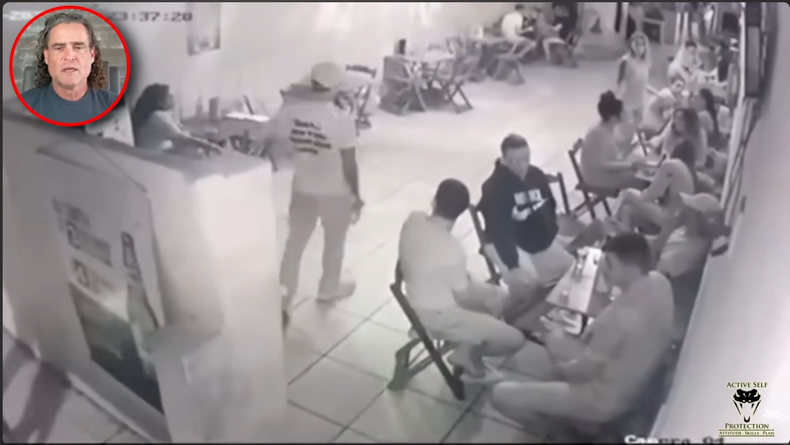
In this footage from Brazil, four friends are sitting together when two armed men walk in. One draws immediately and shoves his gun directly into a victim's face. Within seconds, the room erupts — two defenders returning fire, two attackers neutralized, and two good guys wounded but alive.
It is chaotic, fast, and brutally instructive.
This is one of the best real-world examples of what it actually looks like to fight multiple armed attackers — and what separates the people who survive from the ones who don't.
What Happened
A group of four friends are seated together when two men enter. The first — wearing a hat — moves immediately toward the group and draws a gun, announcing a robbery. His partner follows close behind.
One of the seated men, in a black sweater, goes for his gun the moment the barrel comes within reach of his face. What follows is a full gunfight: the man in black grappling with the first attacker while the second attacker opens fire, and a second defender — seated nearby — waiting, watching, and choosing his moment before drawing and engaging both attackers.
When it's over, both attackers are down. Two defenders are wounded but alive. The whole thing unfolds in a matter of seconds.
Lesson 1: You Will Always Be Behind — That's the Starting Point
The attacker chose the time. The attacker chose the place. The attacker chose the moment to draw.
This is the fundamental reality of any defensive encounter: you start at an initiative deficit. The aggressor acts first. You react. That gap — the time between their move and your response — is the terrain you're working in.
The man in black didn't panic about that gap. He used purposeful compliance — appearing to go along with the robbery while watching for his moment. When the gun came close enough that he judged the threat was immediate, he went. Not before. Not in a way that tipped his hand prematurely. He waited until the moment gave him an edge.
This is evidence-based defensive strategy. Purposeful compliance isn't submission — it's controlled patience that creates the conditions for a counter-ambush. If the opportunity never comes, you comply fully and hope they take your valuables and leave. But if the moment appears, you are ready to take it.
Lesson 2: Every Additional Attacker Multiplies the Difficulty
One armed attacker is a deadly problem.
Two armed attackers isn't twice as hard — it is roughly ten times harder, according to John Correia at Active Self-Protection. The angles multiply. The threats multiply. Every round you put on one attacker is a moment your back is exposed to the other.
The man in black knew both attackers were armed before he moved. He chose to go anyway, because at close range with a gun at his face, the calculus shifted — waiting was more dangerous than acting.
That's the decision framework worth understanding: the threshold for action changes based on immediacy. Two armed men at a distance — comply and look for opportunity. One gun pressed to your face — go now, with everything you have. Speed, surprise, and violence of action are your only advantages once that moment arrives.
Lesson 3: Wait for Your Visual Signal — Then Go Immediately
The second defender is the quiet hero of this footage.
While his friend is grappling with the first attacker, he sits still. He is watching. He is ready. And he waits until the attackers' backs are turned — his visual signal — before he draws.
That patience is not passivity. It is tactical discipline. He understood that drawing early, into an attacker who could see him, with his friend in the line of fire, was worse than waiting. So he waited.
The moment the angle opened — the moment he had a clear opportunity without putting his friend at greater risk — he drew and went to work.
This is what mental rehearsal looks like in practice. He didn't have to think about whether to act. He had a pre-set condition: when I see the back of his head and my friend is out of the line of fire, I go. His body went where his mind had already been.
If you carry, have those conditions pre-set. What is your visual signal? What tells you the moment has arrived? Thinking through that now, in the calm of your living room, is what allows you to act in the chaos of a real encounter.
Lesson 4: Two Hands on the Gun — Always
One of the clearest technical lessons from this footage: the second defender fires one-handed.
Correia flags this directly — one-handed shooting under stress, at distance, in a dynamic environment significantly reduces accuracy. And accuracy is what ends fights. Misses don't.
Two hands on the gun is not a preference. It is the mechanical reality of how accurate, fast, fight-stopping shots are delivered. A two-handed grip gives you better recoil management, faster split times between shots, and a more stable sight picture when your hands are shaking from adrenaline.
In a close-quarters encounter, the instinct is often to use one hand — to push, grab, or shield with the other. Train against that instinct. When your gun is in your hand, both hands go on the gun. Full stop.
Lesson 5: Capacity Matters When the Math Gets Ugly
Two attackers. Multiple rounds fired. Two defenders wounded but continuing to fight.
This footage is a direct argument for carrying enough gun.
Correia is careful not to be dogmatic here — a five-shot revolver is infinitely better than no gun, and in the hands of a true expert it can be enough. But he's honest: in a scenario with two armed attackers, where both are absorbing rounds and continuing to fight, a higher-capacity semi-automatic changes your odds meaningfully.
His personal standard: at minimum, a micro-9 with 10+1 capacity. Something that fits in a small package but gives you the round count to address multiple threats, take a follow-up shot, and still have ammunition left when the situation resolves.
The principle isn't "carry the biggest gun possible." The principle is: match your carry to the realistic threat environment you live in. If fights like this exist — and they do — what does your setup look like in that scenario?
Lesson 6: You Can Be Hit and Keep Fighting
Both defenders took hits in this incident. Neither stopped fighting.
This is one of the most important and least-discussed realities of armed self-defense: a gunshot wound does not automatically end a fight. Adrenaline, will, and the mechanics of the human body mean that people — both good guys and bad guys — can absorb rounds and continue to be a threat or continue to defend.
The takeaway is twofold. First, do not assume a hit on your attacker means the fight is over. Keep your gun on target, assess, and continue to address the threat until it stops. Second, if you are hit, stay in the fight. You may be more capable than you realize in the moment. The fight is not over because you've been wounded.
This is uncomfortable to sit with. But the defenders in this footage are alive because they didn't stop.
What This Means for Your Home Defense Setup
The defenders in this footage survived because their guns were on their bodies — immediately available the moment the situation demanded it. There was no retrieval. No fumbling. No delay.
At home, that same principle applies: your defensive firearm is only useful if you can reach it before the situation is already decided.
A traditional gun safe — combination lock, back closet, bolted to the floor — is excellent for storage. It is poor for defense. The seconds it takes to cross your home, remember a combination under stress, and retrieve your firearm are seconds the situation is already developing without you.
This is the gap that gun concealment furniture was designed to close.
A concealment shelf staged at a natural choke point in your home — the top of the stairs, beside the bedroom door, in the main living area — keeps your firearm within reach without broadcasting its location to anyone who walks through your door. RFID activation means one motion, no combination, no keys. The same speed and decisiveness the defenders in this footage needed is available to you at home.
Our gun concealment mirrors offer the same fast access in a form that works in bedrooms and entryways — indistinguishable from standard home décor, immediately accessible to you.
Because when the moment arrives, your setup either supports fast action or it doesn't. There is no middle ground.
Action Checklist: Multiple Attacker Scenarios
- Use purposeful compliance — appear cooperative while watching for your moment. Don't telegraph.
- Set your visual signal in advance — know what condition tells you it's time to act.
- Go with everything when the moment comes — speed, surprise, violence of action.
- Two hands on the gun — every time, every shot.
- Address the biggest threat first, then transition — don't linger.
- Stay in the fight if you're hit — assess your capability and keep going.
- Know your round count — carry enough gun for realistic scenarios.
Final Thought
Nobody walks into a restaurant or bar expecting two armed men to announce a robbery. Nobody plans for it. Nobody wants it.
But some people are ready for it anyway — because they've thought it through, they've trained for it, and when the moment came, they already knew what to do.
The defenders in this footage were wounded. They were outnumbered. They were behind from the first second.
They are alive.
That is what preparation looks like when the stakes are real.
Explore our gun concealment furniture and hidden gun storage solutions — built for people who take their responsibility to protect their families seriously, without turning their home into a tactical showcase.
Ready when you need it. Hidden when you don't.


