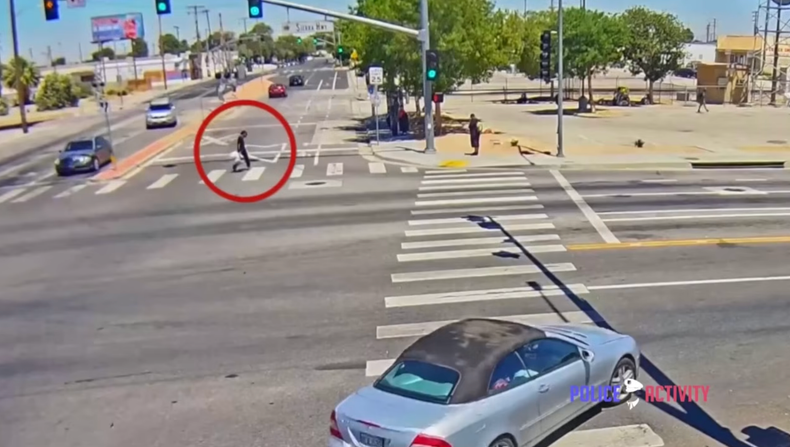
Location: Lancaster, California — June 20, 2026 Video Source: Humilitas First (Ret. Lt. Todd Heaton)
Nobody in that parking lot thought they were in danger.
A man was walking around swinging two knives — as if, in the words of the 911 caller, he was fighting with someone. Someone only he could see. Civilians were nearby. A woman was walking toward the bus stop. People were going about their day.
And then the deputies arrived. And in the time it took one of them to get out of his patrol vehicle — a matter of seconds — the suspect had closed the distance and stabbed him.
Ret. Lt. Todd Heaton of Humilitas First breaks this one down with the same surgical precision he brings to every incident. The lessons are not just for law enforcement. They are for anyone who parks a car, walks through a lot, or gets out of a vehicle in public — which is to say, everyone.
The core principle: proximity is king, and transitions are opportunities for those who know how to exploit them.
The question is whether that someone is you — or the threat.
What Happened
Deputies responded to calls about an assault suspect armed with multiple knives in Lancaster, California. When they arrived, the suspect — described as unhoused and behaving erratically — had already been walking through the area swinging two knives, apparently engaged in a confrontation with something no one else could see.
A civilian in the parking lot handled the initial encounter reasonably well — facing the threat, moving offline when line of sight was broken, using a utility pole as a minor obstacle. But the deputies' arrival created a new dynamic. The suspect, spotting the patrol vehicles, began moving at a 90-degree angle into the parking lot — expanding distance, buying himself time, and positioning for what came next.
When the first deputy's vehicle stopped, it took him approximately 2.5 seconds to exit. In that window — that transition — the suspect closed the distance and stabbed him.
Seconds. That's all it took.
Lesson 1: Transitions Are Where You Are Most Vulnerable
Heaton opens with a principle worth writing on the wall: getting out of your car is a transition. And transitions are opportunities — for whoever understands how to exploit them.
Think about what happens when you park and exit a vehicle. You put it in park. You turn it off. You release your seatbelt. You open the door. You stand up. You gather whatever you're carrying. You orient yourself to your surroundings.
That sequence takes the average person 30 seconds or more. Heaton timed himself trying to be intentional and efficient — park, seatbelt, off, door, stand — and clocked just under 6 seconds. The deputy in this footage, trained and prepared, took 2.5 seconds because he had already propped the door open with his foot before the car stopped.
Two and a half seconds. And it wasn't enough.
This is the uncomfortable truth about transitional spaces: you are at your most vulnerable when you are moving between states of relative security. Car to sidewalk. Parking lot to store entrance. Driveway to front door. These seams in your day are where predators — human and otherwise — look for opportunity. Not because they are sophisticated tacticians, but because they understand instinctively that people in transitions are distracted, slowed, and temporarily unable to respond.
Don't be most people. Master the transitions.
Lesson 2: You Have Less Time Than You Think
Heaton makes this point repeatedly and it deserves to land: people consistently overestimate how much time they have.
Pride is part of it. We tell ourselves we would react faster, notice sooner, respond more effectively. But the math of distance and movement is indifferent to confidence. A person walking — not running, just walking — covers roughly 5 feet per second. At 30 yards, a determined threat is on you in under 20 seconds. At the distances involved in this parking lot encounter, the window was measured in single-digit seconds.
Heaton's practical exercise is worth doing: time yourself getting out of your car. Then time your spouse. Then your kids. The numbers will surprise you. Thirty seconds is common for someone not thinking about it. That is 150 feet of ground a walking threat can cover while you are still gathering your coffee and your phone.
Distance equals time. Time equals options. The further you are from a threat when you first identify it, the more choices you have. The closer they get before you recognize the problem, the fewer options remain.
Know the math. Then make decisions accordingly.
Lesson 3: Read the Pre-Attack Signals Early
The civilian in this footage did several things right — and Heaton credits him for it while also pointing out where he fell short.
The right: when the suspect stopped short at just over two yards, the civilian faced him directly. He didn't overreact or flee. He watched. When the suspect pivoted and gave him a blind spot — distracted by an approaching patrol car — the civilian moved offline immediately. He created distance. He broke the line of sight and repositioned. He put a minor obstacle between himself and the threat.
These are not complicated tactics. They are the product of one thing: paying attention to the world around him and reading what he saw accurately.
The suspect had been swinging two knives moments earlier. That is not subtle. That is a neon sign that something is wrong. The civilian who reads that sign early — who gives that person a wide berth, who moves offline before the encounter reaches critical distance — is the one who never has to make a harder decision.
The lesson Heaton drives home: when line of sight is broken, move. Don't stay where they last saw you. People are lazy. Predators expect their target to be where they left them. Surprise them by not being there.
Lesson 4: Never Give Your Back to a Known Threat
Here is where the civilian in this footage lost points.
As the suspect walked away — apparently responding to the approaching patrol vehicle — the civilian briefly turned his back. Heaton flags this directly: you do not give your back to someone you have reason not to trust.
The logic is simple. If an attack is coming, it comes when your back is turned. That is when the distance closes fastest, when you have the least warning, and when your reaction time is at its worst. A threat at your back is a threat you cannot see until it is already upon you.
The presence of a patrol car nearby does not change this calculus. Law enforcement may not reach you in time. The civilian in this footage may have been the caller — may have known police were coming — and still should not have assumed that proximity to a squad car made him safe. You may have to solve this problem yourself. Do not count on anyone else to solve it for you before the situation resolves.
Keep the threat in your field of view. Keep moving. Keep your front toward the danger.
Lesson 5: The 90-Degree Angle Is a Weapon — Use It
Both the suspect and the well-trained civilian in this footage used the same tactical principle, from opposite sides of the encounter: moving offline at a 90-degree angle.
When the deputies' vehicles appeared, the suspect immediately moved at 90 degrees into the parking lot — not fleeing directly away, but expanding distance laterally, forcing any pursuit to turn and follow, buying himself time and a heads-up if they closed in.
When the suspect gave the civilian a blind spot, the civilian moved offline as well — not directly backward, but laterally, breaking line of sight while expanding distance.
This principle applies in every transitional environment. If you identify a threat and need to create distance, moving directly backward is the slowest and most predictable option. Moving at an angle — offline from their line of approach — expands distance faster, breaks their targeting, and puts you somewhere they don't expect.
At the gas station, the parking lot, the driveway — if something concerns you and line of sight breaks, move offline. Don't be where they expect you to be.
Lesson 6: Back In. Nose Out.
Heaton makes a point so practical it almost sounds mundane — until you think through the implications.
When parking in any area where you have concerns, back into the space rather than nosing in.
Nosing in means your exit requires reversing — slower, more maneuvering, less visibility. It means when you are trying to leave quickly, you are at your most vulnerable. It means if a threat approaches while you are still in the vehicle, you are facing away from it.
Backing in means your exit is a straight pull-forward. It means when you get out, you are facing the direction you came from and can see what's approaching. It means if the situation deteriorates while you're still behind the wheel, you drive forward and leave — no reverse, no three-point turn, no delay.
In the scenario Heaton describes — a suspect like the one in this footage at distance in a parking lot — nosing in means losing line of sight during the parking process. In the time it takes to park and exit, a walking threat covers the distance. Backing in keeps your eyes on the problem while you settle into the space.
Small habit. Significant advantage.
What This Means for Your Home
Everything Heaton teaches about transitional spaces in public applies inside the walls of your home — and in the space between your car and your front door.
The driveway is a transition. The walk from your car to the door is a transition. The moment you step out of your vehicle, oriented away from the street, keys in hand, focused on the door — that is your most vulnerable moment as a homeowner.
We have covered this in previous posts. The data bears it out. A significant portion of home-related violent crime does not happen inside the home — it happens in the approach. In that seam between the street and the threshold.
Once you are inside, the same principle applies to how your home is set up for defense. A firearm in a back bedroom safe requires you to cross your home — a transition — before you are armed. Every step of that transition is time the situation is developing without you.
Gun concealment furniture eliminates that transition. A concealment shelf positioned at a natural gathering point — the living room, the top of the stairs, the hallway near the front door — means your defensive firearm is already at the point where you need it. No crossing the house. No combination under stress. One motion, RFID-activated, immediate access.
Our gun concealment mirrors serve the same purpose in bedrooms and entryways — indistinguishable from standard décor, immediately available to you when the transition from asleep to alert happens faster than you planned.
Heaton's lesson applies directly: be more efficient through the transitions. In your home, that efficiency starts with where your tools are staged.
Action Checklist: Mastering Transitional Spaces
- Time your vehicle exit — know exactly how long it takes you to park and get out. Then work to reduce it.
- Back into parking spaces in any area where you have concerns — nose out, eyes forward, exit ready.
- Scan before you open the door — look at the lot, the people, anything that has moved since you arrived.
- Move offline when line of sight breaks — don't stay where a threat last saw you.
- Never give your back to a known concern — keep the threat in your field of view, even if it means an awkward exit.
- Give erratic behavior a wide berth early — the pre-attack signals are usually visible before the attack. Read them and act on them.
- Stage your home defense tools at transitional points — not where they are convenient to store, but where you will need them.
Final Thought
The deputy who was stabbed in that Lancaster parking lot was trained. He was prepared. He had his door propped open before the car stopped. He was doing nearly everything right.
And in 2.5 seconds, the gap closed anyway.
This is not an argument for fatalism. It is an argument for relentless efficiency — in your awareness, in your movement, in your transitions, and in how your tools are staged when you need them most.
Proximity is king. Transitions are the battlefield.
Master them, and you take back time. Let them happen to you, and time runs out fast.
Explore our hidden gun storage furniture and gun concealment mirrors — built for people who understand that readiness is not a state of mind. It is a setup.
Because the threat doesn't wait for you to be ready.
Be ready first.


