Jordan Salinas woke up like any other day.
Coffee. YouTube. Plans to visit some horses up in Hagerman with his girlfriend. They decided to grab food first — In-N-Out had just opened a new location in Twin Falls, and he hadn't eaten breakfast yet.
He pulled into a spot across the street. Before he even got out of his car, a wave of people came flooding out of the restaurant. His brain searched for an explanation — maybe a fire. Then they kept running. Then he heard the rifle.
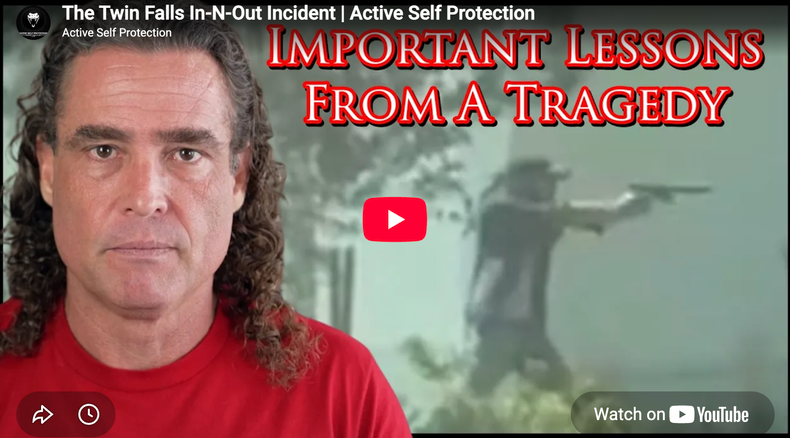
What happened next put Jordan Salinas into the defensive community conversation permanently. Armed with a suppressed FN 5.7, in cowboy boots, with no military or law enforcement background — just consistent weekly training and the willingness to act — he engaged an active killer who was firing into traffic at a busy intersection.
He didn't stop the threat with a shot. But he did something arguably more important: he put the killer on his heels, stripped away his sense of control, and drove him away from a crowd of innocent people. The killer eventually took his own life as officers closed in.
Three people died that day. Without the armed citizens who responded — Jordan among them — that number almost certainly would have been much higher.
There is a lot to learn here. Let's get into it.
What Happened
The incident began when the gunman drove through the In-N-Out drive-thru and shot the first victim at the payment window. He then shot a second victim in his vehicle before exiting his car and continuing his rampage on foot.
Three armed individuals responded before police arrived:
Austin James, a former Twin Falls police officer and former Idaho State Police trooper, ran toward the incident unarmed and was critically wounded before he could draw. He survived — but the way he was carrying his firearm played a significant role in the outcome of his engagement, a lesson we'll return to.
An off-duty Idaho State Police trooper inside the restaurant helped evacuate staff and patrons, then engaged the shooter through the drive-thru window at approximately 5 yards — and missed. The shooter returned fire, retreated, and retrieved a rifle from his vehicle.
A woman — described by Jordan himself as perhaps the bravest person in the entire incident — spotted the shooter's abandoned, malfunctioning handgun, ducked behind his car, picked it up, and attempted to use it. Unable to clear the malfunction, she tossed it and ran. No training. No hesitation. Just pure instinct to do something.
Then Jordan moved.
He observed from a piece of soft cover — the tall In-N-Out sign — gathered what intel he could from a fleeing bystander, confirmed an active shooter, and advanced to a second position. When the shooter appeared at the intersection, hipfiring into stopped traffic, Jordan engaged from approximately 50 yards. The shooter flinched visibly on the first shot. Jordan fired approximately four more rounds, experienced a malfunction, cleared it, and engaged again. When the shooter moved behind the Teslas — removing Jordan's safe backstop — he repositioned rather than fire into an unsafe angle.
His final engagement drove the shooter away from the crowd entirely. From that point, the killer was running — not hunting. Officers arrived shortly after. The shooter ultimately died by a self-inflicted gunshot wound at the canyon's edge.
Lesson 1: Always Carry. You Don't Get to Choose When It Matters.
Jordan had no idea what August 1st held when he woke up that morning.
He was going to see some horses. He wanted In-N-Out. It was a normal Saturday.
This is the foundational truth that every carrier instinctively understands and that every non-carrier tends to underestimate: you do not get to choose when the worst day happens. You only get to choose whether you are prepared for it.
Jordan was carrying — as he is every single day without exception. That was not a decision he made on August 1st. It was a decision he made a long time ago and has simply never walked back from.
As John Correia puts it plainly: rule number one of gunfighting is have a gun. If you don't have it, you can't use it. The option simply does not exist.
The three people who died that day were not given a choice. The people who survived — many of them — had Jordan, an off-duty trooper, and a former officer making decisions on their behalf. That's what being a prepared citizen actually means in practice.
Lesson 2: Carry Chambered. Every Single Time.
Austin James is a hero. Full stop. He ran toward an active killer without hesitation and paid for it with a shattered bone and a severed artery.
But there is a critical lesson buried in his story that Correia does not shy away from: Austin James was carrying his firearm without a round in the chamber.
When he was shot and his dominant arm was taken out of the fight, he drew with his non-dominant hand — and could not get the gun into action because he had no free hand to rack the slide.
This is not a hypothetical. This is what happened.
People who carry unchambered typically do so out of a concern for safety — a fear of an accidental discharge. That concern is understandable but misplaced when you are carrying in a quality holster that covers the trigger guard. A proper holster makes an unintentional discharge essentially impossible. What it cannot do is rack your slide for you when one hand is no longer functional.
Carry chambered. In a quality holster. Every time. The gun exists to be used in the worst moment of your life — make sure it is ready when that moment arrives, regardless of what condition your body is in.
Lesson 3: Marksmanship Is a Skill — Invest in It Before You Need It.
Two armed, willing defenders — a trained off-duty trooper and a well-practiced civilian — engaged the shooter and did not achieve confirmed hits. The only wound on the perpetrator was self-inflicted.
Correia addresses this directly and without sugarcoating: the off-duty trooper had a shot at 5 yards and missed. That miss allowed the shooter to continue. Two more people died in the time that followed.
This is not an indictment of the trooper — he is a hero who ran toward danger under extreme stress. But it is a clear-eyed lesson about the reality of marksmanship under pressure. Most people — including many law enforcement officers — do not train enough with their handguns to shoot accurately when their hands are shaking, their heart rate is maxed, and someone is pointing a gun back at them.
Jordan's miss at distance is far more understandable — 50 to 60 yards, outdoors, moving target, subsonic rounds through a suppressor. That is an objectively difficult shot under any conditions. But his training gave him the fundamentals automatically. Grip, sight alignment, trigger press — he didn't have to think about them. They were already there.
Train. Train regularly. Train under pressure. The fundamentals need to be so deeply ingrained that stress cannot disrupt them. If you are not putting in regular range time and dry fire, you are carrying a tool you do not yet fully know how to use.
Lesson 4: A Pistol-Mounted Optic Is No Longer Optional for Serious Carriers.
Jordan was shooting at 50 to 60 yards with a pistol. Correia makes the point emphatically: a pistol-mounted optic changes the math on shots like this fundamentally.
Iron sights at distance, under stress, require a level of precision that is difficult to maintain even for experienced shooters. A quality red dot — properly zeroed — allows a shooter to place the dot on the target and press the trigger without the complex sight picture alignment that irons demand. At 50 yards with a 9mm zeroed at 25 yards, a competent shooter with a dot can hit reliably. With irons under stress, the same shot becomes exponentially harder.
The defensive community has been slow to adopt pistol-mounted optics on carry guns, but the evidence from real-world incidents is making the argument clearer every year. If you are carrying for serious defensive purposes — including the possibility of an active killer scenario — a dot is worth the investment and the training to run it well.
Lesson 5: Gather Intel Before You Commit — Then Act Decisively.
One of the most instructive details from Jordan's interview is what he did before he drew his gun.
He took cover. He observed. He stopped a fleeing bystander and asked two questions: What's going on? What does he look like, what is he wearing?
The bystander kept running before he could answer the second question. But the first answer — active shooter — was enough. Jordan had confirmed the threat category. He moved.
This sequence — observe, orient, decide, act — is textbook. But it is remarkably difficult to execute when everything in your body is screaming to either run or react immediately. Jordan did it in a parking lot, in cowboy boots, with no military training, because he had thought through this kind of scenario enough times that the process was available to him under pressure.
Know what your trigger is. Know what confirmation you need before you act. And once you have it — act.
Lesson 6: Backstop Awareness Is Non-Negotiable.
There is a moment in Jordan's engagement that deserves specific recognition — not for what he did, but for what he chose not to do.
When the shooter moved behind the parked Teslas, Jordan had a visual on him. He wanted to engage. He did not — because the Teslas were now his backstop, and there were people near them.
He repositioned instead. Found a new angle. Confirmed a safe backstop — a brick service building — and engaged again.
That decision, made in a fraction of a second under extreme stress, is the mark of someone who has genuinely internalized the fundamentals of responsible use of force. You are accountable for every round that leaves your barrel. A miss at an active killer that strikes an innocent bystander is not an acceptable outcome. Jordan knew that and made the harder choice in real time.
Backstop awareness is not just a range rule. It is a life-or-death responsibility in a dynamic environment.
Lesson 7: You Don't Have to Win the Fight — You Have to Change It.
Jordan Selenus did not put the killer down. He did not land a confirmed hit. By some narrow definitions, he "missed."
By any meaningful definition, he won.
He engaged a man who believed he had complete control of a public space. He introduced resistance the killer had not anticipated. He drove him away from a crowd of stopped vehicles and into a retreat that ended with officers in pursuit and the killer cornered. The shooter went from hunting to running in the span of Jordan's first engagement.
As the interviewer puts it: "Whether or not you impacted him — you helped end that situation."
Sometimes the goal is not the final shot. Sometimes the goal is to take away the initiative, introduce chaos into the attacker's plan, and force them to react rather than act. Jordan did exactly that. The outcome of August 1st would have looked very different without him.
What This Means for Your Home Defense Setup
Every person in this incident who made a positive difference shared one thing: their tool was on their body when the moment arrived.
Jordan was carrying. The off-duty trooper was carrying. The woman who grabbed the shooter's gun was improvising because she wasn't — and she still tried.
At home, the equation shifts slightly but the principle is the same. Your firearm needs to be where you are, or within immediate reach of where you will be when a threat materializes. Not across the house. Not in a safe that requires a combination. Not on the nightstand in a room you might not be in.
Gun concealment furniture closes that gap. A concealment shelf positioned at a natural gathering point in your home — the living room, the top of the stairs, the hallway outside your bedroom — keeps a defensive firearm within reach without advertising its presence to anyone who walks through your door.
RFID activation means one motion in the dark, under stress, with no combination to remember. The same readiness Jordan had on his hip at In-N-Out is available to you at home — staged, accessible, and invisible to anyone who doesn't already know it's there.
Our gun concealment mirrors bring that same access to bedrooms and entryways, indistinguishable from standard home décor.
Because if August 1st in Twin Falls taught us anything, it's this: the moment does not announce itself. You are either ready or you are not. There is no in between.
A Final Word on Jordan Selenus
Jordan was asked in his interview what he wanted people to know.
He talked about the community. About the memorials he attended before he agreed to tell his story. About the victims' families. About how heartbreaking and heartwarming it all was at the same time.
He did not talk about himself.
He was just a man who trained every weekend, carried every day, and happened to be in the right place to make a difference. No military background. No law enforcement experience. Just preparation, discipline, and the willingness to act when it mattered.
"If not me, who? If not now, when?"
That is the question every responsible armed citizen has already answered — before the moment ever arrives.
Train. Carry. Be ready.
Explore our gun concealment furniture and hidden gun storage solutions — built for people who take that answer seriously.
Because preparation is not something you find in the moment.
It is something you bring to it.


