Most people think winning a gunfight comes down to who shoots first.
This footage from Wilkinsburg, Pennsylvania tells a different story.
A police officer encounters an armed man approaching his squad car — yelling, taunting, firearm in hand. Rather than standing his ground and trading shots in the open, the officer does something that looks, at first glance, like retreat. He moves. He gets small. He lets the threat come to him.
And then, at exactly the right moment, in exactly the right position, he ends it.
What this officer did wasn't luck. It was a masterclass in positioning, timing, and psychology — and the lessons apply just as directly to a homeowner defending their family as they do to a patrol officer on the street.
What Happened
While on patrol in Wilkinsburg, an officer encounters an armed man who begins advancing toward his squad car. The officer gives multiple lawful commands to drop the weapon. The man ignores them, continuing to approach while yelling and taunting.
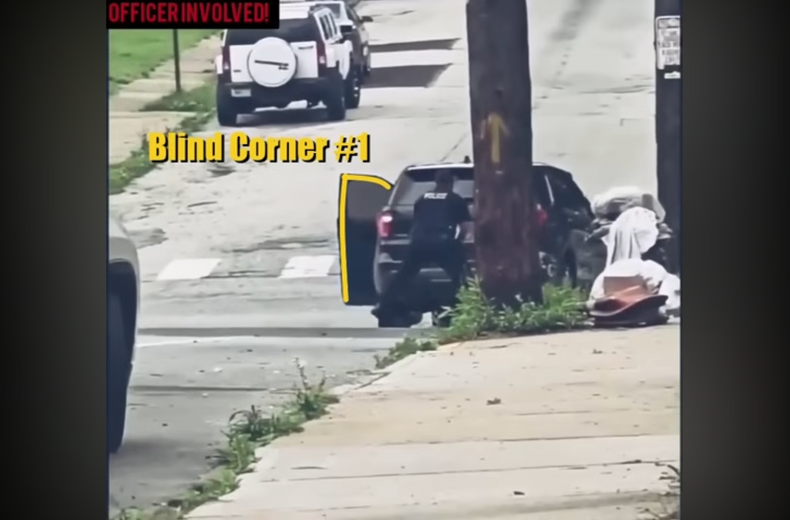
Rather than engaging from where he stood, the officer opened his driver's side door wide and left it open — then began moving around the rear of the vehicle, using it for cover. The aggressor, reading the officer's movement as fear and retreat, followed confidently around the front of the car.
What he didn't realize was that he was being led. The open door created a visual obstruction. The vehicle created two blind corners in rapid succession. And the officer was waiting just inside the second one, two-handed grip, ready up — positioned before the threat even knew where he was.
As the aggressor stepped into the light, the officer fired. One shot, center mass. Threat stopped.
Lesson 1: Sooner Beats Faster
The opening frame of this footage says everything: the officer is up, two-handed grip, before the aggressor has his weapon raised.
Ret. Lt. Todd Heaton's observation is precise — sooner beats faster. It doesn't matter how quickly someone can draw and fire if you are already on target before they begin to move. The officer understood this. He wasn't trying to outdraw the threat. He was positioning himself so that when the moment came, he was already ahead of it.
This reframes the entire conversation about defensive readiness. Speed matters. But position and preparation matter more. A person who is already in a stable, two-handed shooting platform behind cover will outperform a faster draw from a standing, exposed position almost every time.
The same principle applies at home. The homeowner who hears something in the night and is already positioned — at a choke point, with a defensive firearm in hand, using the door frame for cover — is operating from a position of advantage before any confrontation begins. The one fumbling across the house to find a gun in the dark is not.
Lesson 2: Use Positioning and Psychology Together
The officer did something tactically brilliant that also carried significant psychological weight: he made himself look like he was running.
By moving away from the aggressor — getting small, moving to the rear of the vehicle — he allowed the threat to believe he had the upper hand. The aggressor read the officer's movement as fear. He became confident. He became less careful. He closed the distance without the caution he might have shown if he believed the officer was ready and waiting.
Heaton calls this humbling yourself to gain an advantage. There is no ego in it. The officer didn't need the aggressor to know he was prepared. He needed the aggressor to walk into a position of maximum disadvantage — and the appearance of retreat got him there.
For a civilian defender, this thinking is particularly valuable. You are not a police officer. You do not have to stand and announce your position. Moving, repositioning, and using your environment to stack corners and blind spots in your favor is not cowardice — it is tactics. Every second you buy by repositioning is a second the threat is operating on incomplete information about where you are and what you're ready to do.
Lesson 3: Stack Blind Corners — Make the Threat Navigate to You
The open car door was not an accident. The officer left it open deliberately, and it served two purposes.
First, it created a focal shift — something the aggressor had to visually process as he moved around the front of the vehicle. Second, it stacked a second visual obstruction directly before the one the officer was using. By the time the aggressor cleared the first blind corner and felt confident, the second one was already in front of him — and the officer was waiting just inside it.
Two blind corners in rapid succession. The aggressor had to navigate both, and by the time he cleared enough of the second to see the officer, it was already over.
Transitions are vulnerabilities. Every time a threat has to move around a corner, through a doorway, or past an obstruction, there is a moment of exposure — a moment where their attention is split between navigating the obstacle and tracking the threat. The officer exploited that moment perfectly.
This is directly applicable to home defense. Your home is full of corners, doorways, and hallways — and if an intruder is moving through your home toward you, each one of those is an opportunity. A homeowner who understands this positions themselves at the far side of a corner, in a low-profile stance, and waits. They do not go looking for the threat. They make the threat come to them, through a funnel of their choosing, where they hold every advantage.
Lesson 4: Reaction Time Is Real — Don't Give the Initiative Back
One of the most technically precise points Heaton makes involves reaction time, and it's worth understanding clearly.
Once you have the initiative — once you are positioned, ready, and the threat is moving toward you — maintain it. Every time you stop and wait for the threat to act before you respond, you are giving the initiative back. And action beats reaction, every time, up to the limits of human physiology.
In this footage, after the officer fires his first round, the aggressor raises his pistol. The officer's reaction time — from the moment the aggressor begins to raise the weapon to the moment the officer begins to respond — is just over half a second. That is fast by any measure. But the aggressor raised his weapon in four-tenths of a second. The math is uncomfortable.
The lesson: once you achieve the initiative, maintain it. Do not pause and wait for the threat to give you permission to act. Your goal is to stop the threat. That means continuing to act until one of two conditions is met — the threat surrenders clearly and completely, or the threat is no longer capable of continuing.
When the threat is down and done, you are done. Not before, and not after.
Lesson 5: The Legal Battlefield Is a Real Consideration
Heaton raises a point that most tactical breakdowns skip entirely: why would an officer use these specific tactics when engaging in the open might have been faster?
His answer is candid. An officer who is visibly being pursued — who can be seen on camera moving away from an advancing threat before firing — is building a legal record that matches the facts. He is not the aggressor. He attempted to create distance. He used cover. He fired only when the threat had closed and the situation was unambiguous.
For a civilian, this matters enormously. The aftermath of a defensive shooting involves law enforcement, prosecutors, and potentially a jury. Every decision you made — did you try to retreat? Did you use cover? Did you fire only when necessary? — will be examined. The tactics that stack the odds on the physical battlefield are often the same ones that stack the odds on the legal one.
Move away from the threat when possible. Use cover. Fire only when the threat is clear, immediate, and unavoidable. These aren't just good tactics — they are the foundation of a legally defensible use of force.
How This Translates to Your Home
The officer in this footage used a vehicle as his cover and a parking lot as his terrain. You have a home — and a home is, tactically speaking, a significant advantage for the defender if you understand how to use it.
Your hallways are funnels. Your doorways are blind corners. Your staircase is a choke point. These are not weaknesses — they are defensive features, but only if you know how to use them and only if you are positioned to take advantage of them before the threat arrives.
That positioning starts with where your defensive firearm is staged.
A gun locked in a back bedroom safe requires you to cross your home, retrieve the firearm, and then find a defensive position — all while the threat is already inside and moving. That sequence is backwards. By the time you are armed, you have already ceded the positional advantage.
Gun concealment furniture solves this by keeping a defensive firearm at the point where you need it — not where it's convenient to store. A concealment shelf positioned near a bedroom door, at the top of a staircase, or covering a main entry hallway means your firearm is already at the choke point. You don't cross the house to get armed. You are armed at the position.
Our gun concealment mirrors serve the same purpose in bedrooms and entryways — RFID-activated, one motion, immediate access. Nothing about their appearance suggests what they are. But you know exactly where they are and exactly how to access them in the dark, under stress, without fumbling.
The officer in this footage won because he was positioned correctly before the confrontation reached its decisive moment. That same logic applies inside your walls.
Action Checklist: Positional Advantage at Home
- Identify your choke points — hallways, staircase landings, doorways are where any intruder must pass. These are your positions of advantage.
- Stage your defensive firearm at the choke point, not across the house in a storage safe.
- Practice moving to your position in the dark, quietly, without hesitation — so that when it matters, it's automatic.
- Use cover, not just concealment — a door frame provides concealment; the wall beside it may provide more protection. Know the difference in your own home.
- Make the threat come to you — do not go looking for an intruder if you can position yourself and wait. You hold every advantage at a blind corner you control.
- Have a plan for after — how you communicate with arriving officers, where your family goes, what you say when you call 911. Think it through now.
Final Thought
The officer in this footage didn't win because he was faster. He won because he was smarter about position, timing, and psychology — long before the trigger was ever pulled.
He led his adversary to a place of maximum disadvantage. He stacked the odds on every battlefield available to him — physical, tactical, and legal. And when the moment came, he was already there.
That kind of preparation doesn't happen in the moment. It happens beforehand — in the thinking, the training, and the setup.
Your home is your terrain. Learn it. Use it. Stage it correctly.
Explore our gun concealment furniture and hidden gun storage solutions — built for homeowners who want every advantage when it matters most.
Position wins fights.
Make sure yours is right.


